
“Content is king.” – by Bill Gates
This quote perfectly sums up the essence of my pitch!
Today I will explore effective content marketing strategies tailored to the travel industry. I’ll present four standout examples of best practice, explain why these outperform others featured in my presentation and highlight the key factors that make them successful at engaging their audiences.
Content marketing is the creation and distribution of valuable and engaging materials that educate and interest your audience throughout the buyers journey.
My first example is a blog article by travel blogger, Nomadic Matt who has effectively identified his niche: budget-conscious travelers. His article, ‘16 Ways to Travel Cheap or Free’ is a standout example of best practice blog content because it relevant and provides practical solutions to ‘the most common travel problem’ — making travel affordable. It effectively uses internal links, guiding users to additional resources that enhance user experience and SEO authority. It’s keyword-rich—using terms like ‘travel cheap’ and ‘travel for free’—and value-driven, offering 16 actionable tips that align with his audiences needs and drive traffic to his blog.
It closes with multiple calls to action: “Stop paying full price for travel!” and promotion of his best-selling book, ‘How to Travel the World on $75 a Day’ which support engagement, lead generation and conversion. Matt’s consistent and conversational tone, builds trust and fosters an emotional connection. Together, they reflect the essential elements of blog content best practices.
Nomadic Matt’s article proves that high-impact content doesn’t require a large team – just a smart strategy and deep understanding of your audience.
How to Travel for Cheap (or Free) in 2025
My second example is the video ‘Ready to switch your POV?’ by Contiki. I felt it was an incredible example of best practice content, demonstrating the power of video to enhance engagement through storytelling. It grabs and holds your attention better than Intrepid’s, creating a deep emotional connection and communicates their message of ‘fun and adventure’ to their 18-35’s demographic. The video is modern and on-trend, speaking directly to its audience in a language they relate to – all within a tight, 30-second format designed for maximum impact. It features catchy, conversational phrases like “The world’s waiting for ya” and “come travel with Contiki,” paired with energetic, upbeat music. The fast-paced editing style keeps viewers engaged and leaves them wanting more. It finishes with strategic CTA’s ‘your young, why not travel now’ and ‘if not now, when?’ prompting the audience to ‘travel together’ with Contiki.
They have successfully used keywords for SEO and hashtags ‘livethelegend’ and ‘traveltogether’ that boosts reach and drives organic traffic to their site. It is a strong example of how aligning content with audience needs and brand voice creates lasting impact.
My third choice is image content best practice by Lonely Planet that illustrates how images speak a thousand words. I felt these 2 images were more effective than Carnival Cruises at stirring emotions and forging a psychological connection that influenced their audience and their travel choices. The first image ‘a man in Jordan with his Lonely Planet book’ captures their unique selling position – ‘solo travel, ‘famous locations’ and ‘adventure’. It takes you on a journey to Jordan where ‘you’ can imagine yourself in that moment.

The second image of a group of backpackers having fun, illustrates the new opportunities and human connection that solo travel creates. Both images create awareness through targeted psycho-graphics that align with their brand story and challenge you to explore the world. In summary, I felt Lonely Planet’s images were better at capturing your attention and creating an emotional connection.

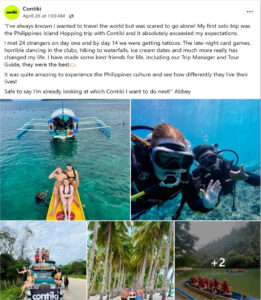
My last example illustrates best practice social media posting strategies using user-generated content. Contiki was a stand out because of its consistent use of this practice, appealing to its Millennials and Gen Z demographic. UGC creates value via first-hand travel experiences that align with their brand narrative of ‘shared adventure’ and ‘travel together’. It gave Contiki the edge over Lonely Planet and Nomadic Matt because user-generated content feels honest and builds trust. Their strategy uses all 3 three UGC forms e.g. written, visual and audio, that improves conversion rates and increases return traffic. They have a regular posting schedule, incorporate CTA’s that drives organic traffic, use questions to prompt conversation and hashtags to amplify reach – all combining to enhance rapport.
Overall, it is a strong example of how UGC drives organic growth and deepen brand loyalty on social media.
All four examples demonstrated key digital best practice techniques relevant to their content marketing channels. Each successfully adopted a customer-focused strategy to emotionally engage the audience, creating a lasting impact and strong emotional connection.